


Carrying Pacific Power into a Global Indigenous Space

Updated: Jan 4
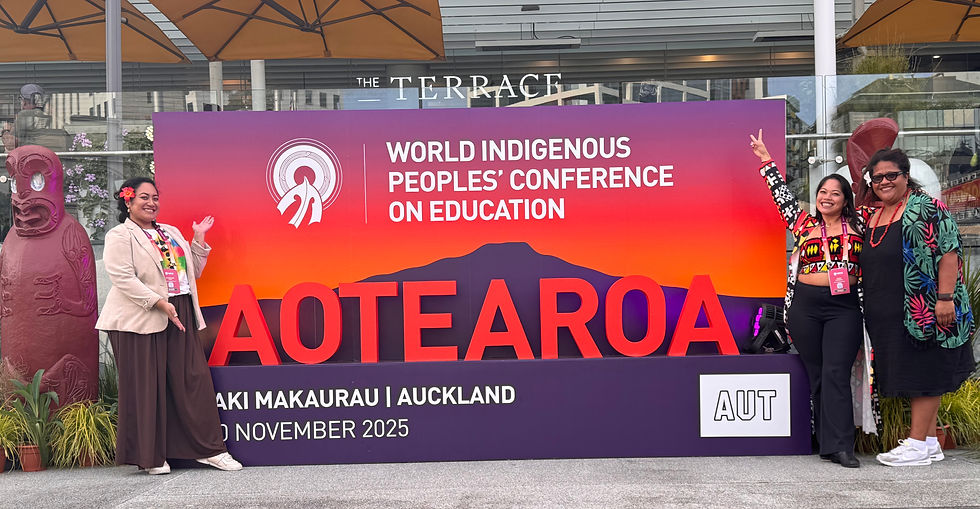
Mana surged through Tāmaki Makaurau as more than 4,000 Indigenous educators were welcomed onto Ngāti Whātua Ōrākei land through a powerful pōwhiri on the 15th November 2025. From the first karanga, we were grounded in whakapapa, collective responsibility, and mutual respect - the perfect way to kick off the week-long World Indigenous Peoples Conference on Education (WIPCE). We carried our ancestors and the youth we serve as we sang, cheered and danced. Feathers and siapo breathing, jingle dresses ringing out across the moana, possum skin cloaks and korowai warming shoulders as ribbon skirts, beads and moccasins carried memories from distant lands.
We knew we were not just being hosted in Aotearoa and the Auckland University of Technology; we were being seen and held. Across the week, story flowed through a rich and expansive programme of keynotes, panel discussions, academic and community presentations and excursions. I was starry-eyed listening to esteemed academics like Professor Linda Tuhiwai Smith (Ngāti Awa, Ngāti Porou, and Tūhourangi) and Associate Professor Kabini Saga (Solomon Islands) speaking on unapologetically Indigenising education spaces. Māori activists like Eru Kapa-Kingi and Rosa Hibbert-Schooner shared how Indigenous education was deeply tied to Indigenous creative expression and Indigenous liberation - something I resonated with deeply as a Pasifika poet and activist. Another amazing keynote speaker, Dr Teina Rongo (Kuki Airani), probably the first Pasifika person in the world to earn a PhD in Marine Biology, shared how the revitalisation of Indigenous ways of knowing and being can only exist if Indigenous lands and waterways are nurtured by Indigenous communities. On the second day of the conference, I was deeply privileged (and nervous!) to present a poster sharing the collective work of the Australian Pasifika Educators Network (APEN).
A central message of our poster, and our presence at WIPCE, was that representation alone is not enough. Presenting at WIPCE felt profoundly aligned because APEN is grounded in Indigenous and Pasifika ways of knowing and being: Talanoa/Tok Stori, vā, and fa‘afaletui. As people approached my poster, they shared how they could relate to how Pasifika peoples have long existed within education systems never designed with Pasifika people in mind. Others shared how they felt that although visibility matters, it does not automatically lead to justice, self-determination, or better outcomes for our learners. Structural accountability, Indigenous and Pasifika-led/Indigenous-led methodologies, and genuine power-sharing are essential. Fellow delegates from Indigenous contexts across the world including Canada, Torres Strait Islands, Aotearoa, Hawai'i and Guam shared a deep understanding of this struggle and the fierce determination to disrupt colonial education systems. As a Samoan woman working within a university and as Secretary of APEN, my clearest realisation at WIPCE was that this experience was never meant to stay with me. My responsibility is to carry these learnings back: to our communities, our students, and to our educators.
The wisdom of elders, the centrality of Indigenous youth, and the bold ways Indigenous peoples across the world are reshaping education must be accessible to all of us. When we lean into relationship, share knowledge generously, and act collectively, our futures become more sustainable and more transformative.As the week drew to a close, even our attire carried the imprint of the gathering. What we wore was not decoration, but declaration. What we spoke on, what we ate, how we expressed our joys and frustrations at systems, how we see others, how we navigate the spaces between us - all these were declarations of our presence. Our presence at the World Indigenous Peoples Conference on Education was an act of sovereignty and visibility, a reminder that Indigenous peoples continue to exist, resist, and lead within education spaces that once sought to erase us. The work now is to carry these conversations forward, grounded in community and guided by care, courage, and collective responsibility.
Comments